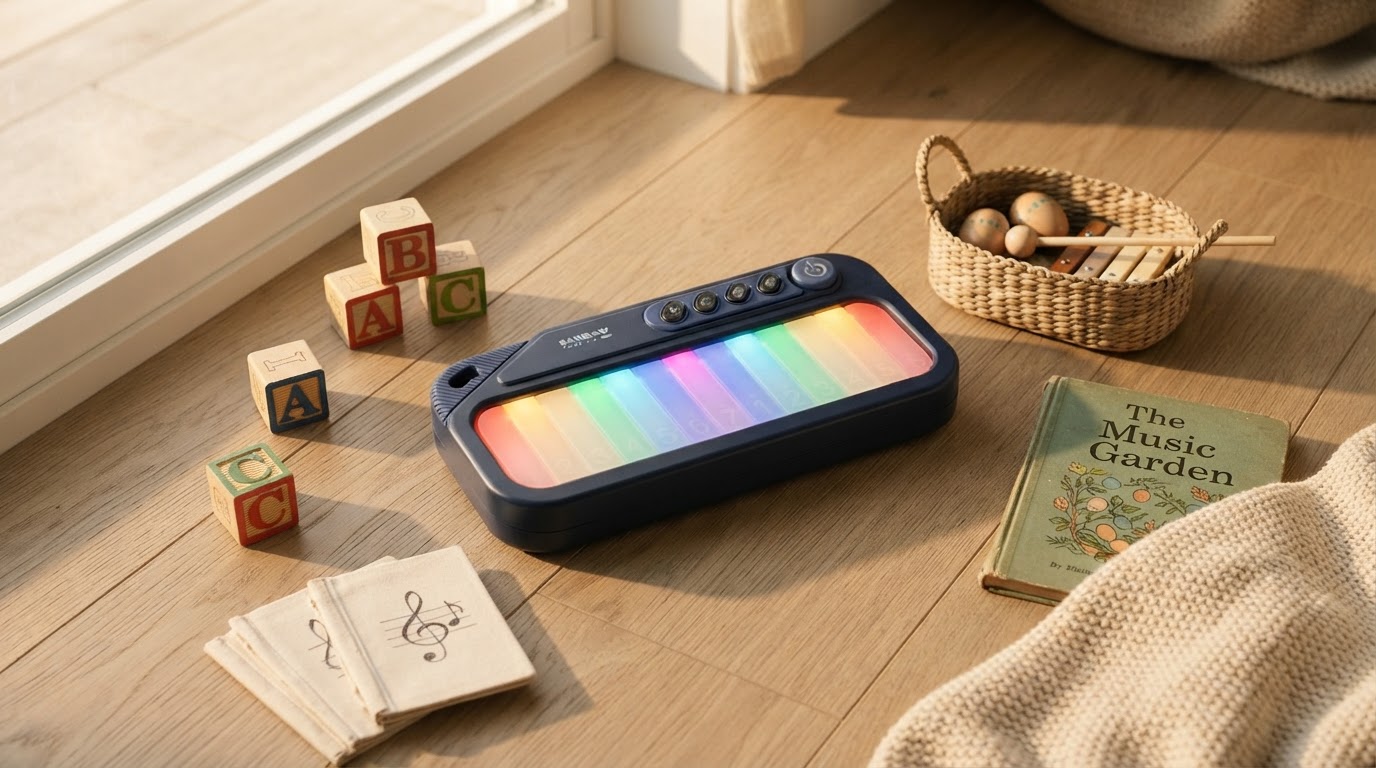
Rainbow Mini Piano for Early Musical Development
 Jordan HaleStaff Writer
August 7, 2026. This exploration details the sensory and developmental impact of the Rainbow Mini Piano on early learners. It is written for parents and educators seeking a tactile, screen-free introduction to music.
The first thing I noticed was the way the morning light hit the silicone keys, turning a quiet living room corner into a spectrum of invitation. There is a specific, soft resistance to the keys that feels substantial yet forgiving under small fingers. In many households, the introduction to music is often a heavy, intimidating affair involving high-gloss wooden benches and the strict pressure of not touching the internal hammers. However, modern play-based learning suggests a different path. According to Rainbow Piano for Toddlers: Learn Notes Through Play, this simple setup helps children recognize notes and build focus without a screen or pressure, utilizing bright keys and gentle lights to anchor their attention. The struggle for most parents is finding a balance between a toy that makes noise and an instrument that makes music. When looking for a small rainbow piano gift, the priority often shifts from simple entertainment to cognitive engagement. We see children gravitating toward colors before they ever grasp the concept of an octave. The challenge lies in translating that natural visual curiosity into a rhythmic understanding. Without a tactile bridge, the gap between a toddler’s interest and a student’s discipline can feel insurmountable. I’ve watched how a child’s posture changes when they realize the red key always produces the same resonant C note; it is a moment of pure, unadulterated discovery that builds the foundation for a rainbow piano gift for musicians later in life.
Photo by Polesie Toys on Pexels
It turns out that the technical specifications of the Rainbow Mini Piano are designed to support this exact transition from play to practice. The device is not merely a colorful mat but a functional instrument featuring 49 keys made of flexible, durable silicone. This portability is a significant factor, as noted in the Rock N Roll It! Rainbow Piano by MukikiM demonstration, which highlights the inclusion of a color-coded booklet for 'Play By Color' learning and a built-in speaker for immediate feedback. The unit is equipped with eight different keyboard tones and six demo songs, allowing a child to explore how a melody changes when shifted from a grand piano sound to a synthesized tone. For those seeking a mini keyboard for kids rainbow, the internal recording and playback functions are perhaps the most vital features. I keep coming back to the sound of a four-year-old recording their first three-note sequence and playing it back with a look of absolute triumph. The inclusion of a headphone jack is a thoughtful touch for shared living spaces, ensuring that the exploration of volume control—another built-in feature—doesn't become a source of household tension. Because it can be powered via a USB cord or batteries, the instrument moves from the playroom to the backseat of a car without losing its settings. This flexibility ensures that the rainbow mini piano remains a constant companion rather than a stationary fixture that gathers dust. The tactile nature of the silicone allows for a roll-up design that fits into a backpack, making it a viable small rainbow piano gift for families who travel or live in smaller urban apartments where a traditional upright piano is an impossibility.
Somewhere around week two, the interaction with the instrument usually shifts from random pressing to intentional sequencing. When deciding if this instrument fits your home environment, it helps to look at the specific needs of the primary user. A rainbow piano gift for musicians might focus on the portability for songwriting on the go, while a parent will focus on the durability of the silicone. To ensure the best experience, consider this framework for integration:
- Verify the space: Ensure you have a flat, hard surface for the silicone keys to lay on to prevent double-triggering of notes.
- Check for connectivity: Confirm you have a standard pair of headphones if you intend to use the silent practice mode.
- Assess the learning style: Determine if the child responds better to visual cues (color-coding) or auditory imitation using the demo songs.
- Plan for power: Keep a USB power source nearby or a fresh set of batteries to maintain the recording memory.
- Integrate the booklet: Use the 'Play By Color' guide immediately to bridge the gap between seeing a color and hearing a pitch.