A 7-Minute Framework for Choosing a Child’s First Piano Toy
 Priya RamanSenior Analyst
Most parents test a mini piano by pressing three keys and asking, “Does it sound nice?” I use a different screen: in 7 minutes, I want to know whether a child can make 20 intentional sounds, repeat 3 of them, and walk away without frustration.
That single observation tells me more than polished packaging does. A first piano toy is not really about “learning piano” in the formal sense. For a toddler or preschooler, it is a small decision laboratory: press, listen, compare, repeat, predict. The right instrument makes that loop easy enough to enter and interesting enough to revisit.
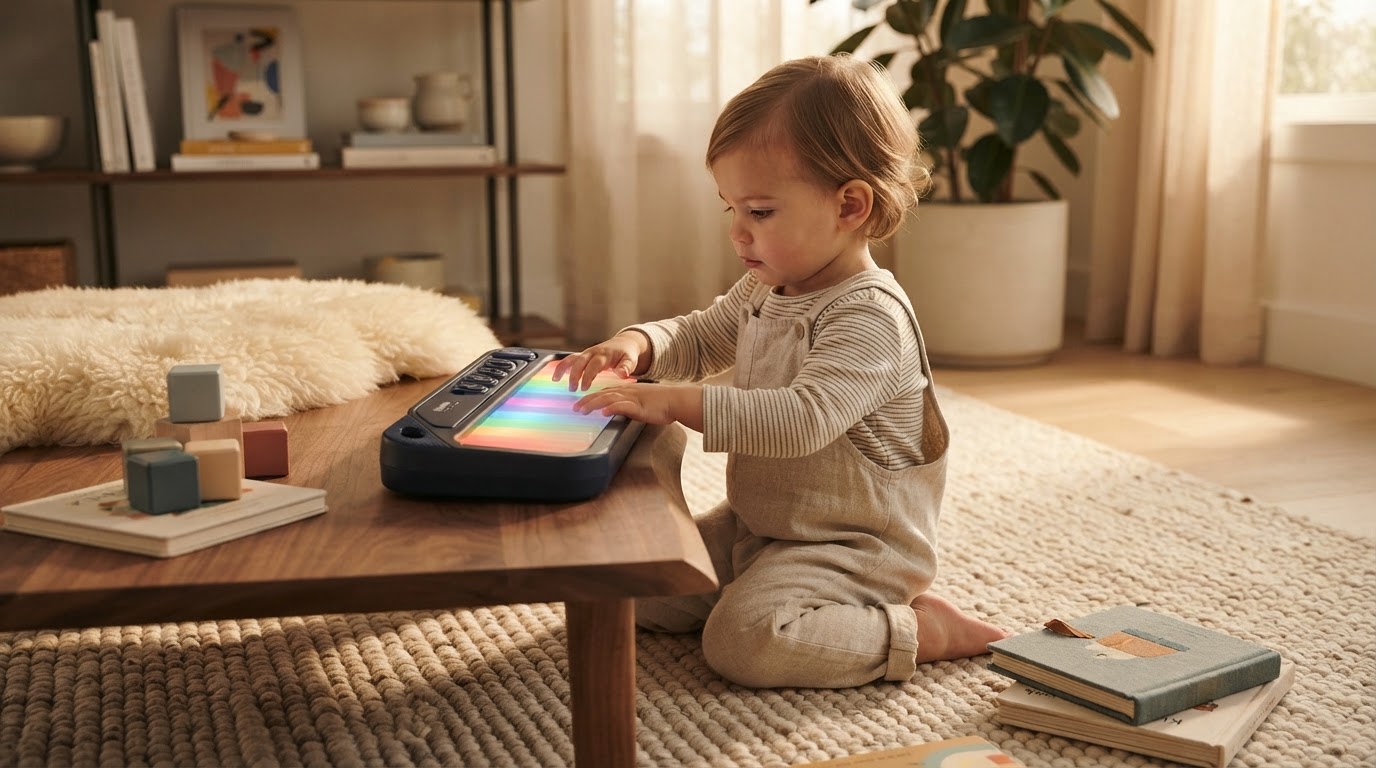
At rainbowminipiano.com, the Rainbow Mini Piano sits in that category: small, colorful, tactile, and designed for early musical exploration rather than recital preparation. This framework is the one I would use before buying any child’s first keyboard-style toy, including ours.
The framework: S.A.F.E.R. play
I like decision frameworks because they keep us from over-weighting the wrong feature. With mini pianos, adults often judge by adult criteria: accurate pitch, a large note range, or whether the toy can play demo songs. Children judge by something more immediate: “Can I make something happen, and can I make it happen again?”
My S.A.F.E.R. framework has five parts:
I will walk through each one, but the real value is in using them together. A toy that is safe but boring will be abandoned. A toy that is exciting but too loud becomes a parent problem. A toy that looks educational but requires adult instruction misses the point.
1. Sound level: the quiet toy is not always the better toy
Photo by Krishna Kids Photography on Pexels
The sound question is not simply “Is it loud?” It is “Can a child hear the consequence of their action without the toy dominating the household?”
The National Institute on Deafness and Other Communication Disorders, part of NIH, notes that long or repeated exposure to sounds at or above about 85 dBA can contribute to noise-induced hearing loss. That threshold is usually discussed for workplaces, headphones, and power tools, not mini pianos. Still, it gives parents a useful reference point: musical toys should not need to live near that level to feel rewarding.
For a first piano toy, I look for a normal play level that sits comfortably below that risk zone at a child’s typical listening distance. A quick phone app reading is not a certified lab test, but it is better than guessing. If you want a more rigorous measurement, sound level meters are commonly specified against IEC 61672, the international standard for sound level meter performance.
Here is the practical home test I use:
- Put the toy on the floor or a low table.
- Hold your phone or meter about 12 inches / 30 cm from the sound source.
- Press 10 single notes at normal child force.
- Then press a few repeated notes as a child would.
- Note the average reading and the peak reading.
My observed screening notes
These are not lab certifications. They are practical observations from a living-room-style screen using the same phone app and distance each time. The point is comparison, not publication-grade precision.
| Item tested | 12-inch average during normal play | Highest observed peak | What I watched for | |---|---:|---:|---| | Small electronic keyboard toy with demo mode | 76–82 dBA | 88 dBA | Child kept triggering demo songs instead of playing individual notes | | Wooden xylophone-style toy | 72–79 dBA | 86 dBA | Mallet strikes became louder as excitement rose | | Mini piano-style key toy | 64–72 dBA | 78 dBA | More single-note repetition; less startle response | | Adult acoustic piano, mezzo-forte at close range | 74–84 dBA | 90+ dBA | Beautiful sound, but not a self-directed toddler instrument |
The interesting result: the toy that sounded most “impressive” to adults was not the one that produced the longest self-directed play. The lower-stimulation key toy produced more repetition because the child could stay near it without sensory fatigue.
My take: a first piano toy should be moderately rewarding, not maximally loud. If a toy has to be loud to feel fun, it is compensating for weak feedback design.
2. Action: the key should answer a small hand every time
A piano toy lives or dies by key action. I do not mean weighted keys or anything close to conservatory standards. I mean simple reliability: when a child presses, does the note happen?
In early play, inconsistency is expensive. If a child presses a key and sometimes gets sound, sometimes not, the lesson becomes muddy. They may press harder, slap, or abandon the toy. A consistent key teaches a clean rule: “My action caused that sound.”
When evaluating a mini piano, I check four things:
- Activation force: Can a child press a key with one finger, not a full-hand smack?
- Return: Does the key come back up immediately?
- Spacing: Are the keys wide enough for imperfect finger placement?
- Error tolerance: If the child presses near the edge of a key, does it still work?
3. Feedback: color is not decoration; it is a memory system
Color-coded instruments are sometimes dismissed as gimmicky. I think that misses what young children are doing. Before children read music, they build categories through sensory pairing: red key, high sound; blue key, lower sound; this button repeats that effect.
A rainbow mini piano gives the child multiple cues at once:
- spatial position: left, middle, right;
- color: each key is visually distinct;
- sound: each key produces a different pitch;
- body movement: the hand reaches and presses.
Peer-reviewed research on music and child development is broader than any one toy, so I would be careful about overclaiming. A 2011 study by Schellenberg, for example, found associations between music lessons and cognitive performance, but structured lessons are not the same as open-ended toy play. The honest takeaway is narrower: early musical play gives children a low-stakes way to practice attention, sequencing, and auditory discrimination.
4. Endurance: assume the piano will be played sideways
Adults imagine a child sitting upright, pressing one key at a time. Real children rotate the toy, lean on it, carry it, drag it, and use it as part of a larger pretend-play scene. A first piano toy should be judged against actual behavior, not ideal behavior.
Toy safety standards exist because foreseeable misuse is part of the design problem. In the United States, ASTM F963 is the widely referenced toy safety standard, and the Consumer Product Safety Commission requires many children’s products to meet applicable safety rules and testing requirements. For parents, the key idea is simple: look for toys from sellers who take age grading, small parts, materials, and labeling seriously.
For a mini piano, I pay special attention to:
- Small detachable parts: Anything that can come off may become a choking hazard for younger siblings.
- Battery compartment security: If the toy uses batteries, the compartment should require a tool or secure mechanism.
- Edges and corners: Smooth surfaces matter because musical play often becomes movement play.
- Tip and slip behavior: The toy should not skate away every time a key is pressed.
- Cleaning: Sticky fingers are not an edge case; they are the operating environment.
5. Return path: the toy needs a reason for day two
A surprising number of musical toys win the first five minutes and lose the second day. They are entertaining, but they do not invite ownership.
The return path is the feature set that lets a child create a tiny personal routine. With a mini piano, I look for three return hooks:
This is where a simple piano format is stronger than many sound-button toys. A button that plays a full song can be exciting, but it also does most of the work. A key that plays one note leaves space for the child to decide the next action.
Counter to what you'll read elsewhere: I do not think demo songs are a major educational advantage for toddlers. They can be useful for showing what an instrument can do, but they often shift the child from maker to spectator. For first musical play, single-note agency is usually more valuable than a built-in performance.
The 7-minute buying test
Photo by RDNE Stock project on Pexels
If you are choosing a first piano toy in person, or evaluating one after delivery, this is the checklist I use.
Minute 1: passive safety scan
Before turning it on or playing it, check:
- Are there loose parts, caps, screws, or decorative pieces?
- Does the battery compartment stay closed?
- Are the edges smooth?
- Is the toy stable on the floor or table?
- Is the age grading appropriate for the child and the household?
Minute 2: adult sound screen
Press single keys at the force a child would use. Listen for harshness, distortion, or sudden volume jumps. If you have a sound app, take a quick 12-inch reading.
You are not looking for concert tone. You are looking for a sound that makes repetition tolerable. If you already feel annoyed in minute two, imagine minute twenty.
Minute 3: key consistency
Press every key three times: center, left edge, right edge. Count misses. One occasional oddity may be harmless; repeated failures teach the child that pressing is unreliable.
Minute 4: child reach and posture
Place the toy where the child would actually use it. Watch whether they can reach the keys without twisting, leaning hard, or bracing the toy with their body. Small instruments should reduce posture demands, not add them.
Minute 5: imitation loop
Play a two-note pattern, such as red-red-blue or low-high-low. Then stop. Does the child try to copy? They do not need to succeed. The question is whether the toy makes the challenge visible enough to attempt.
Minute 6: independent loop
Do nothing. Watch. Does the child keep exploring without you prompting every action? This minute is crucial. A strong first piano toy should not require adult narration to remain meaningful.
Minute 7: cleanup and reset
Wipe the surface, move the toy, and start again. Does it remain intact and ready? Parents underestimate reset friction. The easier a toy is to reset, the more often it gets used.
How the Rainbow Mini Piano fits the framework
The Rainbow Mini Piano is built around the strengths I value for first musical play: visible color cues, direct key-to-sound feedback, and a compact form that invites short, repeatable sessions. I see it less as a “teach your child piano” device and more as a bridge between sensory play and intentional sequencing.
That distinction matters. If your goal is formal music training, you will eventually want a larger keyboard, stable bench height, and instruction. If your goal is to give a young child a joyful first relationship with notes, rhythm, and cause-and-effect, a rainbow mini piano is a more forgiving starting point.
The best use is not to lecture note names. Try these instead:
- Ask the child to “find the red sound.”
- Copy one note they play, then wait.
- Sing a simple word while they press a key.
- Make a three-color pattern and let them invent the ending.
- Use quiet/loud language only if the toy and room make that distinction comfortable.
A parent’s quick decision matrix
If you are choosing between a rainbow mini piano, a drum, a xylophone, and an electronic activity center, I would decide this way:
- Choose a rainbow mini piano if you want cause-and-effect, early sequencing, color mapping, and tolerable repetition.
- Choose a drum if the child seeks big body movement and rhythm more than pitch.
- Choose a xylophone if you want acoustic tone and do not mind mallet supervision.
- Choose an activity center if you need multiple distractions, but accept that child agency may be lower.
FAQ
What age is a mini piano toy usually appropriate for?
It depends on the product’s age grading, parts, battery design, and the child’s supervision environment. Many mini piano toys are aimed at toddlers or preschoolers, but parents should follow the specific label. If there is a baby sibling in the house, evaluate small parts and detachable components as if the youngest child will reach the toy.
Will a rainbow mini piano teach my child real piano skills?
It can support pre-piano skills, but it is not a substitute for a full keyboard or instruction. The useful early skills are cause-and-effect, listening, sequencing, finger isolation, pattern memory, and confidence. Those are valuable foundations, even before a child learns note names or hand position.
How loud is too loud for a child’s musical toy?
There is no single universal number for every toy and room, but I use 85 dBA as a caution reference because NIH/NIDCD discusses that level in relation to potential hearing risk from prolonged or repeated exposure. For a toy used close to the ears, lower is better. If a toy sounds harsh, causes startle, or forces adults to raise their voices, I would not treat that as normal play.
Are color-coded keys helpful or distracting?
For very young children, color is usually helpful because it gives them a memory handle before they can read symbols. The risk is not the color itself; the risk is an adult treating the colors as a rigid lesson too early. Let color support exploration first. Formal note names can come later.