The tiny piano mistake: judging kids’ instruments by notes alone
 Maya ChenContributing Editor
A 25-key mini piano can teach a toddler more useful musical behavior than a 61-key beginner keyboard—if the smaller instrument gets played 5 minutes a day instead of becoming a plastic rectangle under the couch.
That is the claim I’ll defend here, because the usual buying advice points parents in the wrong direction. It says: more keys, more songs, more features, more “real.” I’ve watched the opposite happen in homes and classrooms. The bigger keyboard impresses the adult on purchase day. The smaller, brighter, simpler object gets approached by the child on day four.
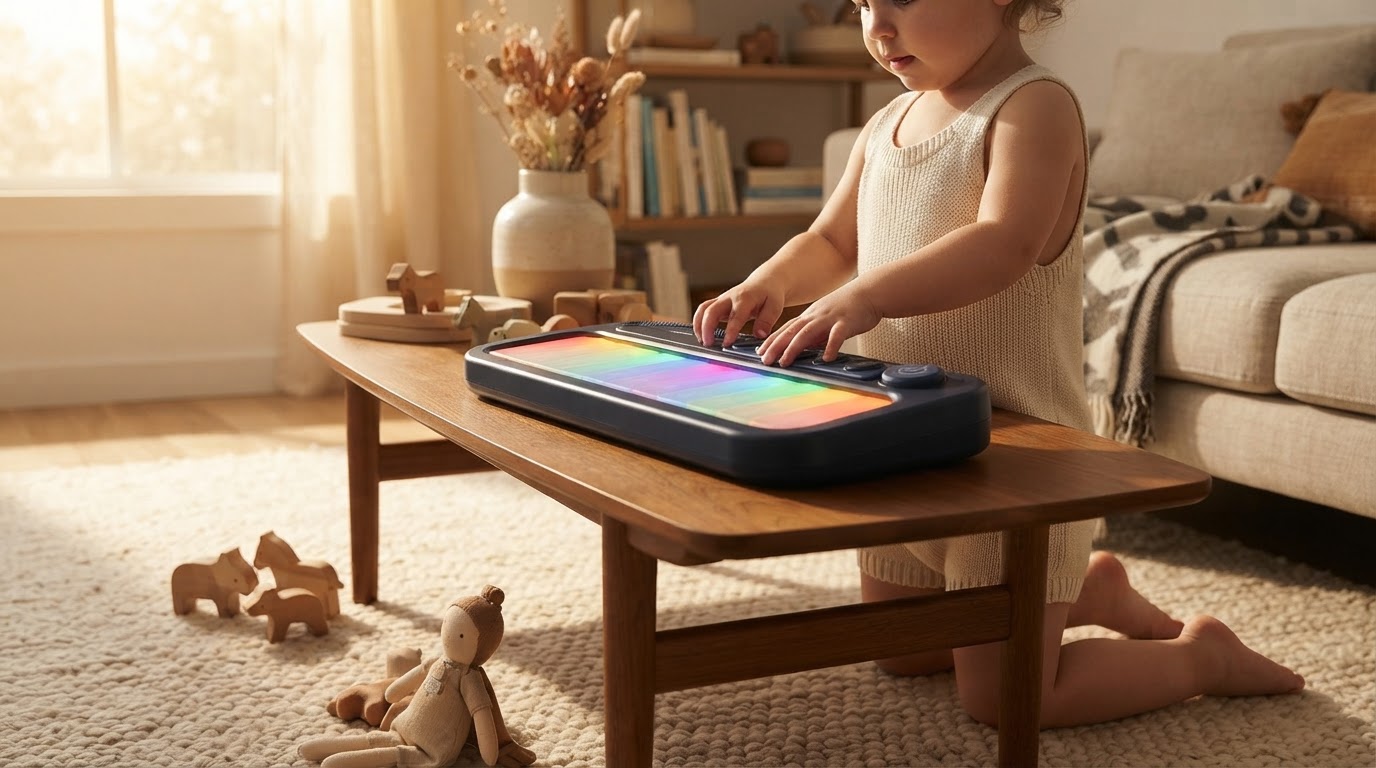
Rainbow Mini Piano sits in that unfashionable category: not a concert instrument, not a screen, not a curriculum-in-a-box. It is a compact, colorful first instrument. And that makes some buyers suspicious. I think that suspicion is often misplaced.
The better question is not, “Is this a real piano?” It is: “Does this object reliably create safe, repeatable, self-initiated sound exploration for a young child?” That question changes the evaluation completely.
The problem with buying “more instrument” too early
Adults tend to judge children’s instruments by adult categories: pitch range, polyphony, pedal input, lesson compatibility, and long-term seriousness. Those are legitimate categories for a seven-year-old starting formal piano. They are not the right first filter for a toddler or preschooler who is still learning that one hand can make one event happen in the world.
In early childhood, the core skill is not “playing piano.” It is mapping: I press this key, this sound happens; I press another key, the sound changes; I repeat a pattern, the room reacts. That is the primitive loop behind rhythm, turn-taking, auditory attention, and eventually musical phrasing.
The National Institute on Deafness and Other Communication Disorders, part of NIH, describes hearing and communication development as a process where children learn by repeated exposure to sounds, speech, and interaction. In other words, the instrument has to be used often enough for the brain to care. A feature list does not create that repetition. A child-friendly object sometimes does.
Here is where mini pianos get underrated: they reduce the number of decisions. A full-size keyboard asks a small child to negotiate scale, reach, buttons, demo songs, volume sliders, and often a forest of flashing icons. A small rainbow piano says: press a colored key, hear a note.
That simplicity is not a defect. It is the product.
What I observed when comparing the “serious” option to the small one
Photo by Pavel Danilyuk on Pexels
I keep a notebook when testing children’s products because memory lies. Adults remember the toy they wanted children to like; children reveal the toy that survives boredom.
Below is a practical observation table from comparing a compact 25-key rainbow-style mini piano with a common 49-key electronic beginner keyboard in a living-room setup. This is not a laboratory study, and I am not pretending it is. It is the kind of use-pattern evidence parents rarely collect before they buy.
| Observation point | Rainbow Mini Piano setup | 49-key electronic keyboard setup | Why it mattered | |---|---:|---:|---| | Visible keys presented to child | 25 | 49 | Fewer choices reduced wandering and button-mashing | | Approx. child reach needed to span instrument | Under 20 in | Over 30 in | Small arms could explore the whole mini piano without standing sideways | | Controls competing with keys | 0–1 obvious control | 10+ buttons on many models | Extra buttons pulled attention away from cause-and-effect playing | | Typical self-start play burst I observed | 3–7 minutes | 1–3 minutes | The smaller instrument was approached more often without adult setup | | Adult instruction needed before first sound | None | Usually “turn it on,” “not that button,” “wait” | Friction mattered more than musical range | | Cleanup/placement friction | Shelf or low table | Stand, outlet, batteries, or floor space | Instruments used daily need to live where children can reach them |
The surprising number is not the key count. It is the self-start play burst. A child who independently returns to an instrument for five minutes is doing something more valuable than posing at a large keyboard for a photo.
I’ve become wary of instruments that require an adult to initiate every session. That turns music into an appointment. Young children often learn better when the object invites small, repeated attempts throughout ordinary life.
Counter to what you’ll read elsewhere:
Counter to what you’ll read elsewhere: a first piano does not need to be “lesson ready” to be educationally serious.
That sentence will irritate some piano teachers. Fair enough. If your child is already taking structured lessons, a mini piano is not a substitute for a weighted or semi-weighted keyboard with enough keys for assigned repertoire. But most Rainbow Mini Piano buyers are not shopping for Chopin. They are shopping for first contact.
For first contact, “lesson ready” can be the wrong standard. It can push families toward instruments that are physically too large, visually too busy, too loud, too dependent on batteries, or simply too precious for a child to freely touch.
A durable, limited, approachable instrument can create the habit before the lesson. Habit is the scarce commodity.
The overlooked safety category: sound level, not just small parts
When parents ask whether a toy instrument is safe, they usually mean choking hazards, paint, splinters, or sharp edges. Those matter. ASTM F963, the major U.S. toy safety standard, addresses mechanical hazards, small parts, and other risks for toys used by children. For any toy sold to young children, compliance with applicable toy safety rules should not be treated as a bonus.
But sound deserves attention too. The Centers for Disease Control and Prevention and NIOSH explain that noise exposure risk depends on both loudness and duration; NIOSH’s recommended exposure limit is 85 dBA over 8 hours, with a 3 dB exchange rate. A piano toy used for short play bursts is not the same exposure as industrial noise, obviously. Still, very loud toys held near the ear are a real concern.
This is another reason I prefer simple acoustic or restrained-output instruments for young children. Many electronic toys are engineered to win attention in a store aisle, not to be pleasant in a kitchen at 7:12 a.m.
A useful parent test is simple:
You do not need a perfect sound meter to notice harshness. If you want a number, many phone apps can give a rough dBA reading. They are not precision instruments, but they can help you compare “this toy in this room” against “that toy in that room.”
Color is not just decoration if it lowers the entry cost
I am skeptical of fake educational claims printed on toy boxes. “Teaches creativity” is usually just packaging fog. Color, however, can do real work when it helps a child return to a pattern.
A rainbow key layout gives adults a language that does not require reading music: “Can you play red, red, blue?” “Can you make a yellow-green-yellow pattern?” “Can your left hand find purple while your right hand finds orange?”
That is not formal notation. It is pre-notation. And pre-notation is useful. Before children decode notes on a staff, they can sort, sequence, remember, imitate, and vary patterns.
The benefit is not that color magically makes music smarter. The benefit is that color gives the adult and child a shared handle. It turns sound into a game that can be repeated.
Peer-reviewed music education research has long separated music aptitude, exposure, and training effects. Studies such as E. Glenn Schellenberg’s work on music lessons and IQ, published in Psychological Science, are often cited in exaggerated ways by marketers. The sober reading is better: structured music experience can be associated with measurable cognitive and social outcomes, but it is not fairy dust. The child still has to engage.
That is why the instrument’s invitation matters.
A decision framework I’d actually use
If you are deciding whether Rainbow Mini Piano makes sense for your child, do not start with age alone. Start with use conditions.
Choose a mini piano when:
- Your child is roughly in the exploratory stage: pressing, repeating, naming colors, copying short patterns.
- You want an instrument that can live in a common area without a full setup ritual.
- You are trying to replace some passive screen time with an object that gives immediate feedback.
- You value independent approach more than formal repertoire.
- You want grandparents, siblings, or caregivers to be able to start simple games without music knowledge.
Skip it, or treat it as secondary, when:
- Your child is already enrolled in piano lessons requiring two-handed pieces across multiple octaves.
- You specifically need weighted keys or dynamic touch sensitivity.
- Your home needs silent headphone practice.
- Your child is under the product’s recommended age range or still mouths small objects aggressively.
- You expect one purchase to serve both toddler exploration and later graded piano exams.
The “five-minute rule” beats the “five-year plan”
I like ambitious parents. I do not like purchasing logic that skips the child in front of us.
A useful rule: buy the instrument that can win five minutes today. Not five hypothetical years of musical seriousness. Five real minutes today, repeated often.
Five minutes of self-directed play can include:
- pressing high and low keys and noticing contrast;
- copying a two-color pattern;
- making “question and answer” sounds with an adult;
- playing softly, then loudly;
- stopping when an adult raises a hand;
- taking turns with a sibling.
The American Academy of Pediatrics has emphasized the importance of play in healthy development, including its role in executive function and caregiver-child interaction. A mini piano is not automatically good play. But it can become good play when the adult uses it for turn-taking, imitation, and variation rather than just noise tolerance.
How to use Rainbow Mini Piano without turning it into homework
Photo by Polesie Toys on Pexels
The fastest way to ruin an early instrument is to hover. Children do not need a lecture on melody before they have enjoyed making a sound.
Use this progression instead.
Week 1: Let the child own the cause
Put the Rainbow Mini Piano on a stable low surface. Let your child press keys without correction. Narrate sparingly: “That was high.” “You played red.” “Now it stopped.”
Do not ask for songs yet. The first lesson is agency.
Week 2: Add imitation
Play two notes and invite a copy. Keep it absurdly short. Red-red. Blue-yellow. High-low. If the child changes it, copy their version once. This tells them music is a conversation, not a compliance test.
Week 3: Add stop-and-go
Play while a stuffed animal “dances.” Freeze the animal when the music stops. This builds inhibition and timing. It also makes silence part of music, which is a concept many electronic toys fail to teach because they fill every gap with demos.
Week 4: Add family patterns
Let each family member choose a color. Make a “name song” by playing those colors in order. Grandparents can do this over video calls. Siblings can compose rules. No one needs to read music.
The goal is not mastery. The goal is recurrence.
Practical buyer checklist
Before you buy or gift a Rainbow Mini Piano, run through this checklist:
- Age fit: Confirm the recommended age range and supervise younger children.
- Surface stability: Plan where it will sit. A wobbly coffee table turns music into frustration.
- Sound comfort: Test loudness in the actual room, at child-ear height.
- Access: Keep it reachable. If it lives in a closet, it is not really owned by the child.
- Adult script: Prepare three games: copy me, stop-and-go, and color pattern.
- Expectations: Treat it as a first-contact instrument, not a conservatory purchase.
- Rotation: If play drops off, remove it for a week and reintroduce it with a new game.
- Care: Wipe keys regularly, especially if multiple children share it.
FAQ
Is Rainbow Mini Piano a real musical instrument or just a toy?
It can be both. For a young child, the toy/instrument distinction is less important than whether it produces repeatable, understandable sound. A mini piano is not equivalent to a full-size piano for lessons, but it can function as a real first instrument for exploring pitch, sequence, rhythm, and turn-taking.
Will a small piano teach bad habits before formal lessons?
Usually, no—provided adults do not pretend it is a full piano technique trainer. Bad habits are more likely when a child is forced into stiff posture, pressured to perform, or corrected constantly. Keep the mini piano at the right height, encourage relaxed hands, and use it for exploration. If formal lessons begin later, the teacher can introduce posture, fingering, and notation on a lesson-appropriate instrument.
How loud is too loud for a child’s piano toy?
There is no single household number that covers every room and play style, but harsh, wince-inducing sound is a warning sign. NIOSH uses 85 dBA over 8 hours as an occupational recommended exposure limit; children’s toy play is different, but the principle still applies: louder sound and longer duration increase risk. Test the instrument at the child’s ear height and avoid toys that encourage playing directly next to the ear.
What age gets the most value from a rainbow mini piano?
The sweet spot is often the period when a child can sit or stand steadily, press intentionally, recognize colors or patterns, and enjoy imitation games. Many toddlers and preschoolers fit that description, but age labels should not override the product’s safety guidance. For older children taking lessons, use the mini piano as a composing toy or sibling-friendly instrument rather than the main practice keyboard.
The bottom line
I do not think every child needs a mini piano. I do think many parents underrate the small instrument because they are shopping with adult pride instead of child behavior.
A Rainbow Mini Piano should be judged by whether it earns repeated contact: small hands returning, patterns emerging, adults joining without taking over, sound staying pleasant enough that the instrument remains in the room. If it does that, the limited range is not a compromise. It is the reason the object works.
The serious first instrument is the one the child actually plays.