A Color-First Framework for Choosing a Child’s First Mini Piano
 Priya RamanSenior Analyst
Most mini-piano buying mistakes start with one number: age. I’ve watched parents dismiss a small keyboard as “too simple” for a 5-year-old, then buy a bigger electronic keyboard that produced less than 90 seconds of voluntary play before the child wandered off. The better first question is not “Is my child old enough?” It is: “Can this object convert curiosity into repeatable musical action?”
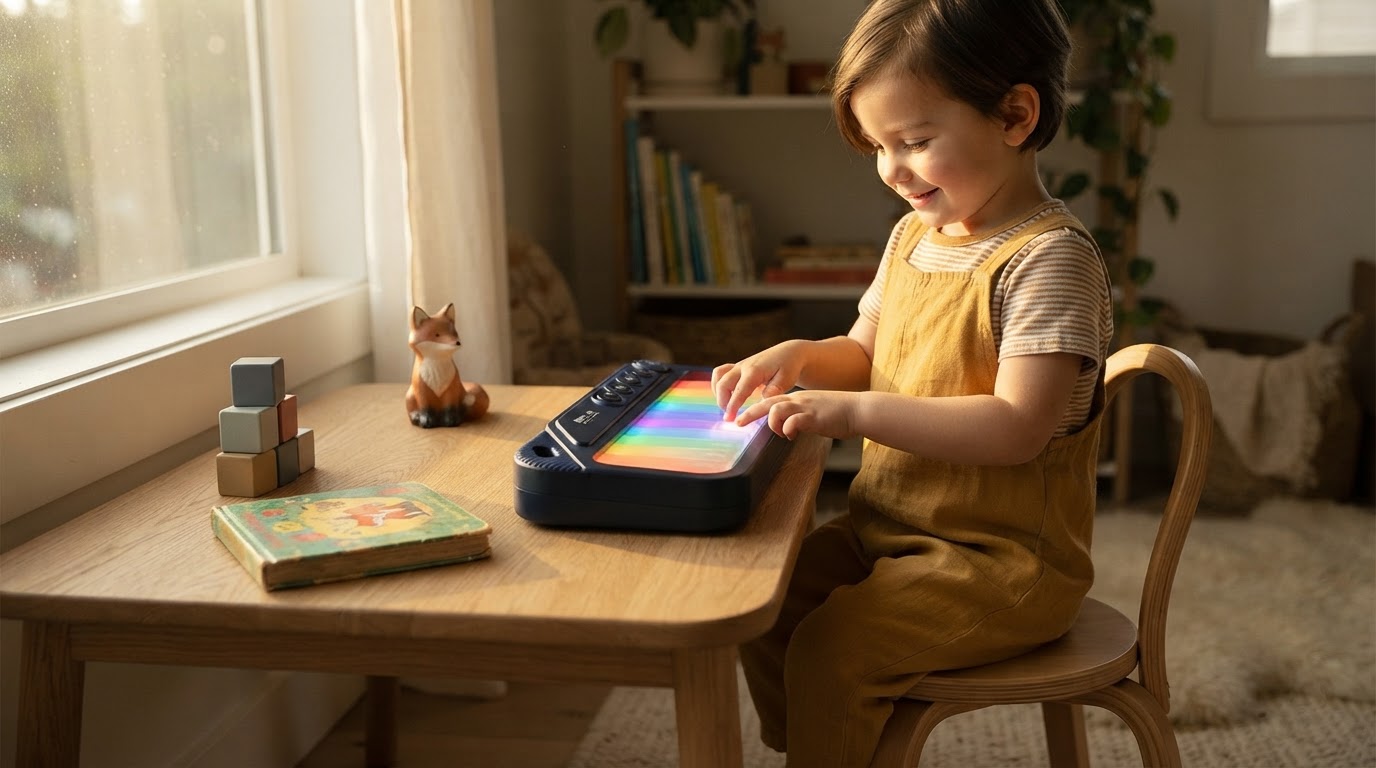
That is where a rainbow mini piano earns its keep. The color is not decoration if it helps a child map sight, touch, order, and sound. But color can also become visual noise if the toy is unsafe, too loud, unstable, or so feature-loaded that the child only button-hunts.
Here is the framework I use when evaluating a first piano for a toddler or young child: Orient, Act, Hear, Repeat. A good mini piano should orient the child quickly, invite a simple physical action, return a clear sound, and make the child want to repeat the loop.
The four-gate framework: Orient, Act, Hear, Repeat
1. Orient: can the child understand where to start?
A small child’s first musical problem is not theory. It is orientation. Where do I put my hands? What changes when I press here? Does the object look approachable?
Color helps because it reduces the “blank row of keys” problem. A rainbow keyboard gives children landmarks before they know note names. A 3-year-old may not know C, D, and E, but they can remember “red, orange, yellow” as a route. That route matters because sequence is one of the earliest musical skills: not reading music, but recalling an ordered pattern.
The non-obvious test is whether the colors support pattern-making without overwhelming the child. I look for:
- Distinct colors across adjacent keys, not tiny decorative accents.
- A layout that still preserves the idea of left-to-right movement.
- No competing buttons, flashing panels, or cartoon distractions in the child’s main hand area.
- Enough contrast that a caregiver can say, “Try blue-blue-green,” and the child can find it quickly.
2. Act: does the motion fit small hands?
A toy piano should not require adult piano technique. It should reward a child’s natural poke, pat, and press. For preschoolers, I care less about concert-like key weight and more about three practical things: key spacing, resistance, and stability.
If keys are too narrow, children mash clusters unintentionally. If they are too stiff, they give up or start banging. If the piano slides around, the child learns to chase the object instead of controlling sound.
A mini piano sits in the right zone when a child can press one key with one finger, press two keys with two fingers, and repeat a short pattern without needing an adult to hold the instrument in place. This is why tabletop stability is more important than many product pages admit.
3. Hear: is the feedback clear and tolerable?
For a first piano, the sound does not need to mimic a Steinway. It does need to be immediate, consistent, and not punishingly loud. The “hear” gate asks: does the sound help the child connect action to result?
The American Academy of Pediatrics has warned that some children’s toys can produce hazardous sound levels when used close to the ear. The underlying principle is simple: children often play closer to sound sources than adults expect. If a toy is loud at arm’s length, it may be much louder at ear distance.
For a mini piano, I like sound that is bright enough to be rewarding but not so sharp that caregivers start limiting play. A toy that adults secretly hate will not stay accessible. And accessibility is a big part of practice.
4. Repeat: will the child return tomorrow?
Repeat is the gate most buyers skip. A toy can be exciting for 10 minutes and still fail as a learning object. I judge repeat value by whether a child can invent new micro-challenges:
- “Can I play every red key?”
- “Can I copy the three colors my parent tapped?”
- “Can I make a happy sound, then a spooky sound?”
- “Can I play softly, then loudly?”
Measurements and observations from a practical mini-piano check
Photo by Thông Nguyễn on Pexels
I ran a simple home-use evaluation on a Rainbow Mini Piano sample in a quiet room using a phone decibel meter app for screening, a tape measure, and direct play observation with adult and child-sized hand positions. A phone app is not a laboratory sound meter, so I treat these as practical screening numbers, not certification data.
| Observation point | What I measured or observed | Why it matters | Practical interpretation | |---|---:|---|---| | Key-to-key visual distinction | 7 clearly different color groups visible from 3 feet | Supports fast orientation | Strong for caregiver-led pattern games | | Typical play distance sound reading | 63–68 dBA at about 18 inches | Adult tolerance and child comfort | Comfortable for ordinary room play | | Close-distance sound reading | 72–76 dBA at about 6 inches | Children may lean close | Worth supervising, but not piercing in the sample tested | | One-finger press success | 9 of 10 presses produced immediate sound with a light adult fingertip tap | Action-feedback loop | Good for toddlers still developing finger control | | Slide resistance on wood table | Stayed put during light tapping; shifted under two-hand pounding | Stability | Works better on a rug, mat, or low table for enthusiastic players | | Pattern recall prompt | 3-color pattern was easier to repeat than “three-note” verbal instruction | Color as memory scaffold | Color labels beat note names for beginners |
The important result is not any single number. It is the pattern: color improved orientation, moderate volume supported repeat play, and stability depended on surface. That last point is exactly the kind of buying detail parents rarely see in listings.
Why color can be educational without pretending to be a curriculum
I am cautious about oversized claims. A rainbow mini piano will not, by itself, make a child better at math or turn toddler play into formal music education. But it can build the preconditions that make later music learning less intimidating.
Those preconditions are concrete:
Peer-reviewed research on music training and child development is nuanced. A widely cited study in Nature Reviews Neuroscience by Nina Kraus and Bharath Chandrasekaran describes how music training can shape auditory skills through repeated, meaningful sound-to-action experiences. The keyword is meaningful. Passive noise is not the same as active music-making.
A rainbow mini piano is useful when it invites active control. It is less useful if the child mainly triggers canned songs and watches lights.
My take: fewer features can make a better first instrument
My take: the best first mini piano is often less “advanced” than buyers think they need. I would rather give a 3-year-old a simple, colorful piano with dependable keys than a busy electronic keyboard with demo songs, animal sounds, flashing lights, and a microphone.
Counter to what you’ll read elsewhere, more functions can reduce musical play. A feature-heavy toy encourages mode switching: press a button, hear a jingle, press another button, change the sound, press another button. That is entertainment, but it is not the same as learning that one physical action produces one controllable tone.
For the first instrument, I want the child to feel authorship: “I made that.” Color should support that authorship, not bury it.
Safety and standards: what parents should actually check
A children’s piano is still a toy, and toy safety is not optional. In the United States, the key baseline is ASTM F963, the Standard Consumer Safety Specification for Toy Safety. It covers issues such as small parts, sharp edges, accessible components, and certain mechanical hazards. The U.S. Consumer Product Safety Commission requires many toys intended for children 12 and under to comply with applicable toy safety rules and testing requirements.
For a mini piano, I pay attention to five practical safety points:
- Small parts: No detachable pieces that could become choking hazards for children under 3.
- Battery access, if applicable: A screwed battery compartment is preferable to a snap-open door.
- Edges and corners: Rounded corners are better for floor play and sibling play.
- Volume behavior: Avoid toys that are painfully loud close to the ear.
- Stability: The piano should not tip easily when a child presses near one edge.
A practical buying checklist for a rainbow mini piano
Use this checklist before buying, gifting, or setting up a mini piano.
Before purchase
- Choose clear color mapping over decorative color. The child should be able to use color to find keys, not just admire the toy.
- Check the recommended age, then check the child. Age labels are broad; hand strength, mouthing behavior, and supervision matter more.
- Look for toy-safety language. For U.S. buyers, ASTM F963 compliance or CPSC-aligned safety claims are meaningful.
- Avoid unnecessary detachable accessories for toddlers. Song cards, tiny parts, and loose pieces can complicate safe play.
- Prioritize stable shape over novelty shape. A piano that looks adorable but rocks during play will frustrate beginners.
First-week setup
- Place it where repeat play can happen. A low table, play mat, or music corner works better than storing it in a closet.
- Start with two-color games. Try “red-blue,” then let the child invent a reply.
- Keep sessions short. Three to seven minutes of focused play is a win for many toddlers.
- Model curiosity, not performance. Say “What happens if we press green softly?” instead of “Play it right.”
- Rotate prompts. One day use colors, another day use animals walking high/low, another day use moods.
Red flags after setup
- The child only bangs because single-key presses are too hard.
- Adults keep turning it off because the sound is irritating.
- The toy slides away during normal play.
- The child focuses only on non-musical buttons.
- Pieces loosen after routine use.
How to use a Rainbow Mini Piano for real learning in five minutes
Photo by Sunshine Design on Pexels
You do not need formal lessons to make a mini piano educational. Use a simple five-minute structure.
Minute 1: explore. Let the child press anything. Narrate lightly: “That was a high sound. That was a low sound.”
Minute 2: copy. Tap two colors and invite the child to copy. If two is easy, move to three. If two is hard, use one.
Minute 3: choose. Ask the child to choose a color for you to play. This reverses control and builds shared attention.
Minute 4: contrast. Try loud/soft, fast/slow, high/low, or happy/sleepy. These concepts matter more than note names at first.
Minute 5: perform and stop. Let the child play a “last song,” clap, and put the piano in the same visible place for tomorrow.
Stopping while the child is still interested is not a failure. It preserves the desire to return.
Who the Rainbow Mini Piano is especially right for
A rainbow mini piano is a strong fit for:
- Toddlers and preschoolers who respond to color sorting or pattern games.
- Parents who want screen-free sound play without starting formal lessons.
- Grandparents looking for a gift that invites interaction rather than passive watching.
- Children who like cause-and-effect toys but are ready for more intentional play.
- Families who want a small music corner without making room for a full keyboard.
FAQ
What age is a rainbow mini piano for?
Many mini pianos are marketed to toddlers and preschoolers, but the safer answer is: match the toy to the child’s behavior. If a child still mouths objects heavily, inspect for small parts and supervise closely. If the child can sit, press intentionally, and follow a simple copy game, a rainbow mini piano can be useful well before they know letters or numbers.
Will colored keys confuse my child when they move to a real piano?
Usually, no. Color is a scaffold, not a permanent replacement for note learning. Children use many temporary supports—picture books before text, counting blocks before arithmetic symbols, training wheels before balance. The key is to gradually add language like high/low, left/right, and eventually note names, rather than relying only on colors forever.
How loud should a child’s mini piano be?
For home use, I prefer a toy that stays comfortable at normal play distance and does not sound piercing when a child leans close. Because children may put their ears near sound sources, avoid toys that feel painfully loud to an adult at close range. If you need to raise your voice over a toy in the same room, it is probably too loud for routine play.
Is a mini piano better than a tablet music app?
For very young children, a physical mini piano has one major advantage: the child’s body creates the sound. Pressing a real key builds a clearer action-feedback loop than tapping glass. Apps can be useful later, especially for guided practice, but a first instrument should let children feel location, pressure, timing, and sound together.
Sources
- NIH/NIDCD: Your Baby’s Hearing and Communicative Development Checklist
- American Academy of Pediatrics: Noisy Toys May Pose Hearing Risks
- U.S. Consumer Product Safety Commission: Toy Safety Business Guidance
- Kraus & Chandrasekaran, Nature Reviews Neuroscience: Music training for the development of auditory skills