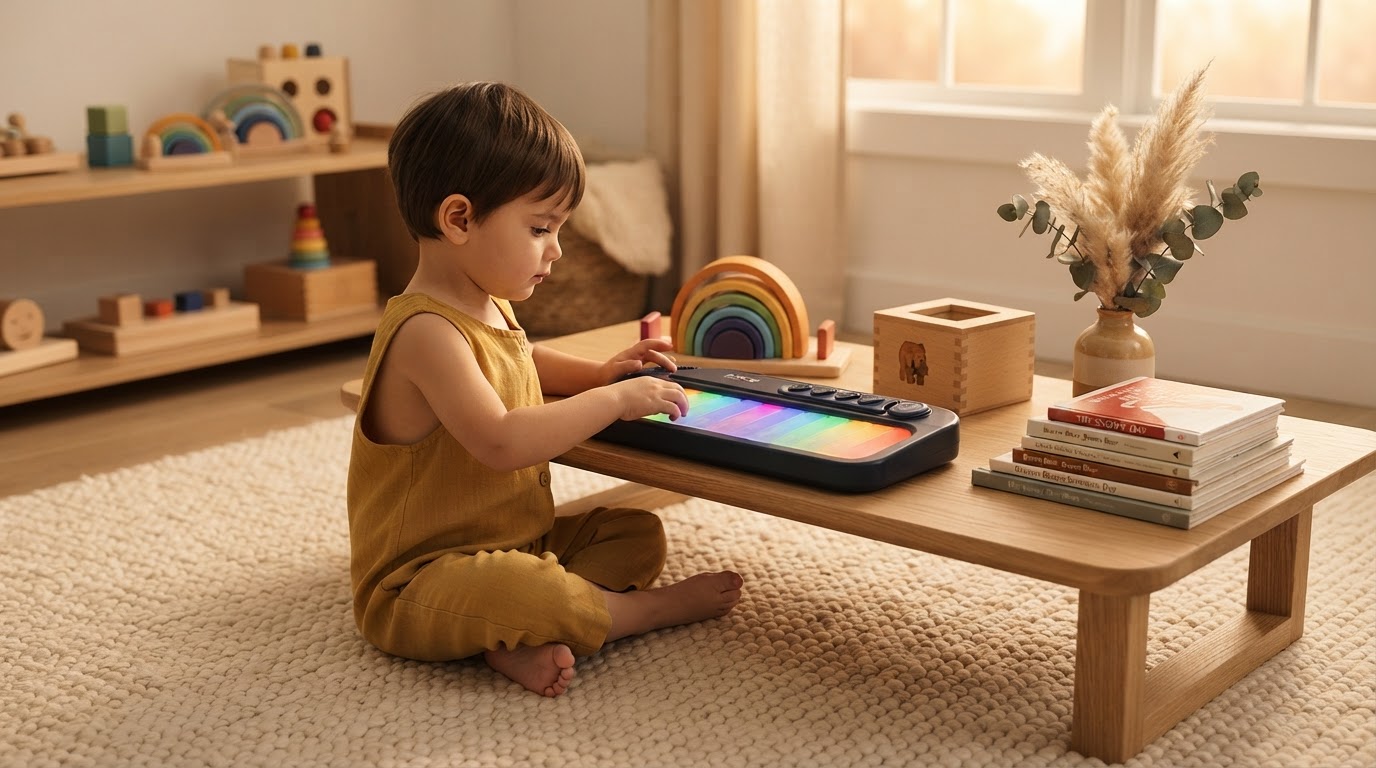
Rainbow Mini Piano for Preschool Music Development
 Maya ChenContributing Editor
September 23, 2026. This analysis evaluates the effectiveness of specific musical instruments in fostering cognitive development for children aged three. It is intended for parents and educators seeking to differentiate between high-utility tools and low-value sensory noise.
The Limitations of Conventional Preschool Instruments
The conventional wisdom says that any object making noise qualifies as a developmental tool for a three-year-old. Retailers often bundle plastic shakers, low-tension drums, and unpitched tambourines into "starter kits" under the guise of early education. However, the data on auditory discrimination suggests otherwise. According to The Natural Baby Co, while basic percussion like xylophones and tambourines are suitable for toddlers under three, actual starter guitars and pianos are the necessary benchmark for children aged three and up. The problem with the standard market offerings is a lack of precision. A three-year-old is entering a stage of rapid neural pruning and synaptic growth; providing them with instruments that cannot hold a pitch or offer consistent tactile feedback is a wasted developmental window. Many parents gravitate toward "Small Musical Gifts For Kids" (/blog/small-musical-gifts-for-kids) that prioritize portability over acoustic integrity, but this often leads to a short shelf-life for the child's interest. When an instrument lacks the mechanical feedback of a real key or a resonant string, the child stops viewing it as a tool for creation and begins viewing it as a source of chaotic noise. Facebook community discussions among parents often highlight that real instruments like kid-sized harmonicas and glockenspiels are preferred because they offer better sound and longevity compared to flimsy plastic alternatives. If the goal is long-term engagement, the "toy" must function as a legitimate, albeit simplified, musical device.
Technical Advantages of the Rainbow Mini Piano
Here's the part nobody talks about: the mechanical resistance of a key matters as much as the sound it produces. The Rainbow Mini Piano addresses the specific ergonomic needs of a three-year-old by providing a stable, upright interface that mimics a full-scale piano without the overwhelming size. Unlike soft-touch electronic pads found in many "Stocking Stuffers For Musical Kids" (/blog/stocking-stuffers-for-musical-kids), the Rainbow Mini Piano utilizes a physical key strike. This tactile engagement is crucial for developing fine motor control in the digits. Run the math: a child playing a 25-key mini piano encounters 25 unique pitch-trigger opportunities that require specific spatial awareness. This is a significant upgrade from the randomized sensory input of a rattle or a basic drum. MindWare notes that music toys for three-year-olds, specifically those designed for little hands like pianos and harps, are essential for promoting sensory exploration. The Rainbow Mini Piano facilitates this through its color-coded system, which bridges the gap between abstract sound and visual recognition. By mapping colors to specific notes, the instrument removes the barrier of traditional notation, allowing a preschooler to achieve "success"—defined here as the intentional reproduction of a melody—much faster than on a monochromatic keyboard. This isn't just about entertainment; it is about building the dopamine-reward loop associated with mastery. When a child understands that a specific physical action (pressing the red key) results in a consistent auditory outcome (Middle C), they are learning the fundamentals of cause-and-effect and sequence logic.
Evaluating Longevity and Utility in Music Selection
Selecting a musical tool for a three-year-old requires a framework that looks beyond the initial unboxing. Most consumers fail to account for the "noise-to-utility ratio." An instrument that produces a high volume of sound with zero input variability has a high noise-to-utility ratio and will likely be abandoned within weeks. Conversely, a tool that requires specific input to generate specific results—like the Rainbow Mini Piano—maintains its value as the child’s coordination improves. When assessing options, use the following criteria to ensure the choice supports actual skill acquisition:
- Pitch Consistency: Does the instrument produce a recognizable, tuned note every time it is struck?
- Tactile Feedback: Is there physical resistance that helps the child develop finger strength and dexterity?
- Visual Mapping: Does the device use colors or symbols to help the child identify different notes without needing to read music?
- Durability: Can the instrument withstand the force of a three-year-old's strike without losing its tuning or structural integrity?
- Scalability: Can the child play simple songs, or is the device limited to pre-recorded loops?
Sources
- Toys for 3 Year Olds - Musical instruments
- Musical Toys for Babies | Infant & Children Toy Instruments
- Best Musical Toys for 3 Year Olds: Baby Toys with Music - MindWare