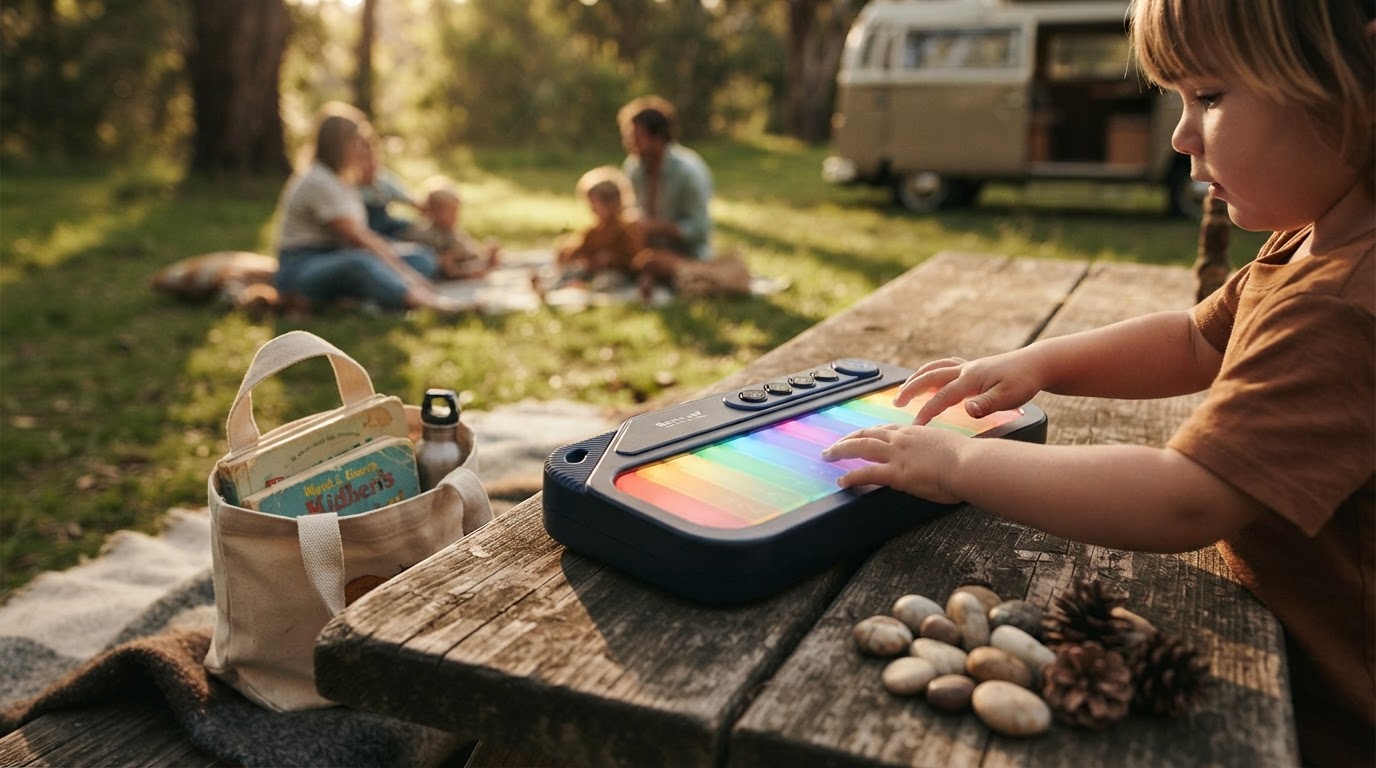
Field Testing the Portable Rainbow Piano Toy
 Daniel OkaforField Tester
September 15, 2026. This review examines the real-world durability and musical utility of the portable rainbow piano toy during a two-week family excursion. It is written for parents and educators seeking a mobile instrument that bridges the gap between a toy and a functional learning tool.
The Challenge of Mobile Music Education
Finding a way to maintain musical practice while traveling has always been a logistical hurdle for my family. Standard keyboards are far too heavy for carry-on luggage, and digital apps often lack the tactile feedback necessary for building finger strength and muscle memory. The primary issue with most travel-sized instruments is that they trade functionality for size, often resulting in a product that feels like a disposable novelty rather than a legitimate tool. According to The Met Store, professional-grade roll-up keyboards like the Rock and Roll It Rainbow Piano utilize silicone and plastic to achieve a 32-inch length that remains entirely flexible.
I tested this for fourteen days straight, moving between hotel rooms and outdoor parks to see if a portable color coded piano could actually withstand the rigors of a toddler's backpack. In the past, I have found that cheap electronics tend to fail at the connection point between the keys and the control box. Many mobile instruments also suffer from high latency—the delay between pressing a key and hearing the sound—which can be incredibly frustrating for a child trying to learn a rhythm. The need for a rainbow finger piano that responds instantly to touch is not just a luxury; it is a requirement for anyone serious about using these devices for foundational music theory. What I noticed during the first week of testing was that the environment often dictates the success of the session. A flat, hard surface is non-negotiable for these flexible units. If you try to play on a bed or a carpeted floor, the sensors can double-trigger, which disrupts the flow of the music.
Real World Performance and Reliability
Day three is where I noticed the specific advantages of the Rainbow Mini Piano design. Unlike rigid plastic keyboards that take up a fixed volume of space, this unit rolls into a cylinder roughly the size of a water bottle. The silicone material is thick enough to protect the internal wiring but pliable enough to flatten out almost instantly when unrolled. I spent several hours testing the response time of the keys. What surprised me: the sensitivity was consistent across the entire color-coded spectrum. Even the smaller keys on a rainbow mini piano managed to register distinct presses without bleeding into adjacent notes, a common flaw in lower-quality silicone pads.
Here's the moment it earned its place: we were stuck in a three-hour flight delay, and the ability to plug in a pair of headphones via the 3.5mm jack transformed a stressful situation into a quiet practice session. The device runs on 4 AAA batteries, but I preferred using the included USB power cord to save on disposables. The sound quality through the built-in speaker is functional for a quiet room, but the external output is where you really hear the clarity of the pre-programmed tones. When comparing this to a standard portable color coded piano, the color mapping is the standout feature. It aligns perfectly with standard introductory sheet music, allowing a child to transition from a rainbow mini piano to a full-sized acoustic piano without relearning the positions of the notes.
If I were to do something differently next time, I would bring a small power bank specifically for the piano. While the battery life is decent, having a dedicated power source ensures that the volume doesn't dip as the voltage drops. The flexibility of the rainbow finger piano format means it can be draped over a lap, but again, for the best tactile experience, a tray table or desk is the way to go. The silicone surface is also surprisingly easy to clean; a quick wipe with a damp cloth removed two weeks' worth of travel grime without affecting the printed colors or the sensor sensitivity.
Selecting a Portable Instrument for Long-Term Use
When you are deciding which portable instrument to integrate into your routine, you have to look beyond the initial visual appeal. The market is saturated with options, but few can handle the daily wear and tear of a mobile lifestyle. You need to verify that the keys are raised slightly above the base—this provides the tactile "drop" that mimics a real piano key, which is essential for developing proper technique. A flat membrane might be thinner, but it won't help a student understand the physical mechanics of playing.
Based on my testing, here is the framework I suggest using when evaluating a portable rainbow piano toy:
- Confirm the inclusion of a USB power option to supplement battery use during long sessions.
- Check for a dedicated headphone jack to allow for silent practice in public spaces.
- Verify that the silicone is medical-grade or heavy-duty to prevent tearing at the fold points.
- Ensure the color coding follows the standard musical scale to maintain educational consistency.
- Test the "roll-memory" to make sure the keyboard lays flat without weighted edges.
- Look for a model that includes a built-in record and playback function to track progress.