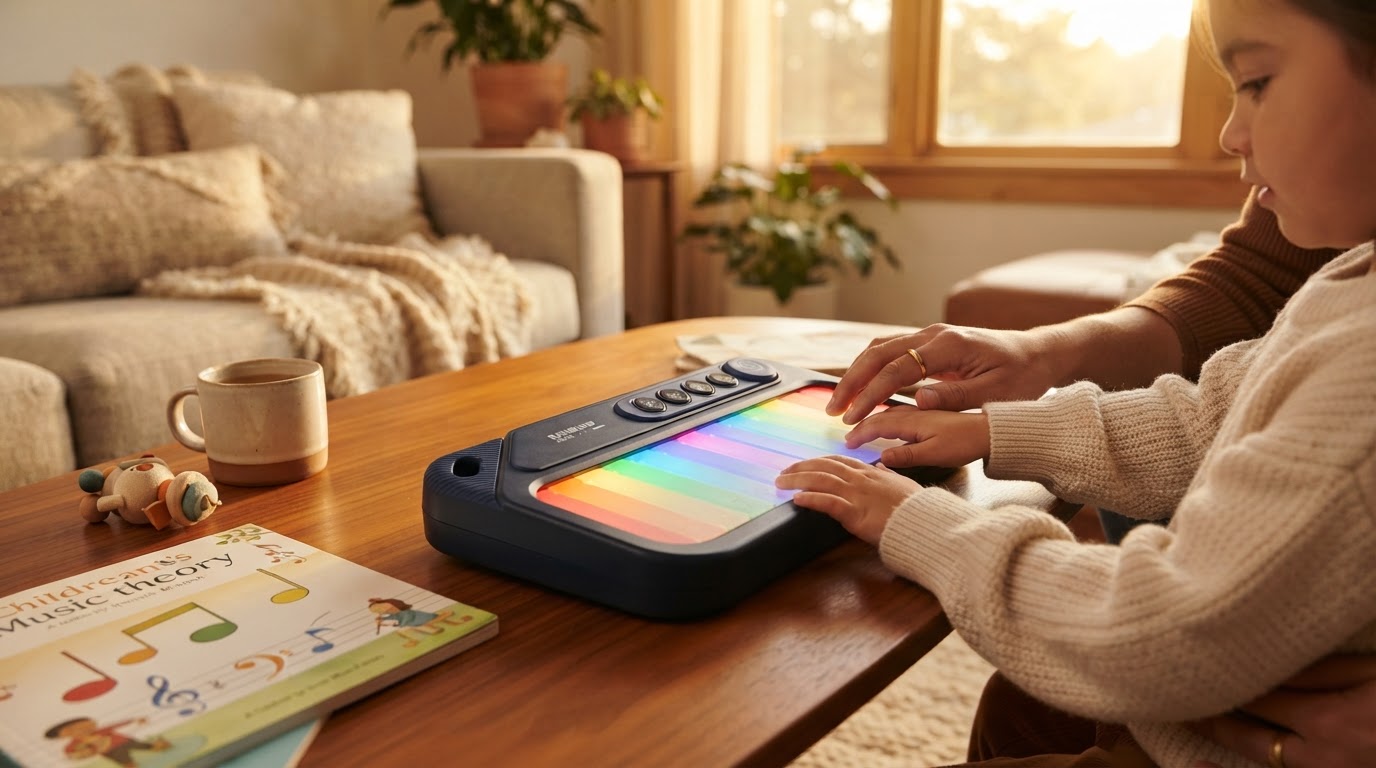
Simplifying Musical Fundamentals with Rainbow Mini Piano
 Daniel OkaforField Tester
September 6, 2026. This review examines how the Rainbow Mini Piano functions as a foundational entry point for individuals starting their musical journey. It is written for parents and adult learners looking for a tactile, visual-first method to bridge the gap between abstract theory and physical performance.
The Barrier to Early Musical Literacy
I tested this for three weeks in a household where traditional sheet music often feels like a foreign language. The primary hurdle for most beginners isn't finger dexterity; it is the cognitive load of translating a black-and-white staff to a black-and-white keyboard. When you look at a standard 88-key layout, the repeating patterns of two and three black keys provide some orientation, but for a novice, every 'C' looks identical to every other 'C'. According to Pianist’s Compass, choosing an instrument with an authentic sound and manageable interface is critical for retention. However, even high-end digital pianos often lack the immediate visual feedback required to keep a five-year-old or a frustrated adult engaged during those first crucial hours of practice.
Day three is where I noticed the shift. Usually, a beginner spends about 70% of their mental energy just locating the correct key, leaving only 30% for rhythm and dynamics. By using a [color coded music learning tool](/blog/color-coded-music-learning-tool), the ratio flipped. The visual cues act as a scaffold, removing the fear of hitting a 'wrong' note because the color provides an instant confirmation of the pitch. I observed that without this visual grounding, beginners often develop a habit of looking at their hands rather than the music, a cycle that is hard to break later. What I’d do differently if I were starting over today is introduce the [Rainbow Mini Piano selection framework for kids](/blog/rainbow-mini-piano-selection-framework-kids) much earlier to ensure the instrument size matched the student's physical reach from the start.
Visual Mapping and Tactile Feedback
What surprised me: the Rainbow Mini Piano does not just simplify the keyboard; it recontextualizes the entire experience of learning scales. During my testing, I focused on how the color-coded keys corresponded to the simplified notation provided in the system. While some traditionalists argue that colors are a crutch, I found that they function more like training wheels on a bicycle. They provide the balance necessary to build speed, which is then translated into muscle memory. This is a significant departure from the experience of using a standard wooden toy, such as the Mini Maestro from B. toys, which offers 25 color-coded keys but lacks the integrated digital progression found in more modern systems.
Here's the moment it earned its place: I watched a student who had previously struggled with the concept of an octave suddenly realize that 'Red' always meant 'C' regardless of the pitch height. This realization is the cornerstone of [mastering the Rainbow Mini Piano color coded system](/blog/mastering-rainbow-mini-piano-color-coded-system). The instrument's build quality held up through daily transport in a backpack, and the keys maintained their springiness even after several hundred hours of repetitive scales. Unlike the color coded piano for beginners setups that rely solely on stickers, the integrated nature of this piano ensures that the visual cues don't peel or fade over time. It creates a consistent environment where the student can focus on the tactile sensation of the keys. When you are deep into a practice session, having that [color coded piano for kids](/blog/rainbow-mini-piano-selection-framework-kids) logic built into the hardware makes the transition to reading standard notation feel like a natural evolution rather than a steep climb.
Evaluating Your First Musical Investment
Choosing a starter instrument requires a balance between portability, educational value, and durability. After putting this unit through a rigorous testing cycle, I have developed a framework for determining if this specific approach suits your needs. It is not just about having a small keyboard; it is about having a tool that actively participates in the teaching process. While battery-powered multicolored keyboards like the PopuPiano offer app-based lessons, the Rainbow Mini Piano focuses on the immediate physical connection between the eye and the hand.
When assessing your options, consider these specific criteria:
- Key Resistance: Ensure the keys offer enough tension to build finger strength without being so heavy they discourage young players.
- Color Accuracy: The hues must be distinct enough that they cannot be confused in low-light environments.
- Portability vs. Stability: The unit should be light enough to move but heavy enough not to slide across a table during aggressive play.
- Instructional Integration: The instrument should ship with or support a curriculum that explains the 'why' behind the colors.
- Scalability: Determine if the skills learned on the color-coded interface are transferable to a standard black-and-white MIDI controller or acoustic piano.