The Montessori Piano Toy Contradiction
 Maya ChenContributing Editor
The popular 5-in-1 "Montessori" piano is a contradiction—real Montessori tools isolate one concept, they don't combine five distractions into a single toy. The market consensus for the `montessori rainbow piano toy` keyword is a multi-activity station that combines a keyboard with drums, cymbals, and light-up features. This analysis rejects that premise, arguing that such designs undermine the core principles of Montessori education by prioritizing sensory bombardment over focused, child-led discovery.
The Flaw in the "5-in-1" Logic
The conventional wisdom says that more features provide more value. In a Montessori context, the opposite is true. The method is built on the principle of isolating a single quality. As outlined by the Association Montessori Internationale, materials in a prepared environment are designed to have a specific point of focus, allowing the child to master one concept at a time without confusion. A toy that combines a piano, a drum, and a xylophone forces a child to process multiple types of sound production and tactile feedback simultaneously. This does not build focus; it creates sensory overload and teaches distraction as a form of play.
Color as a Tool, Not a Decoration
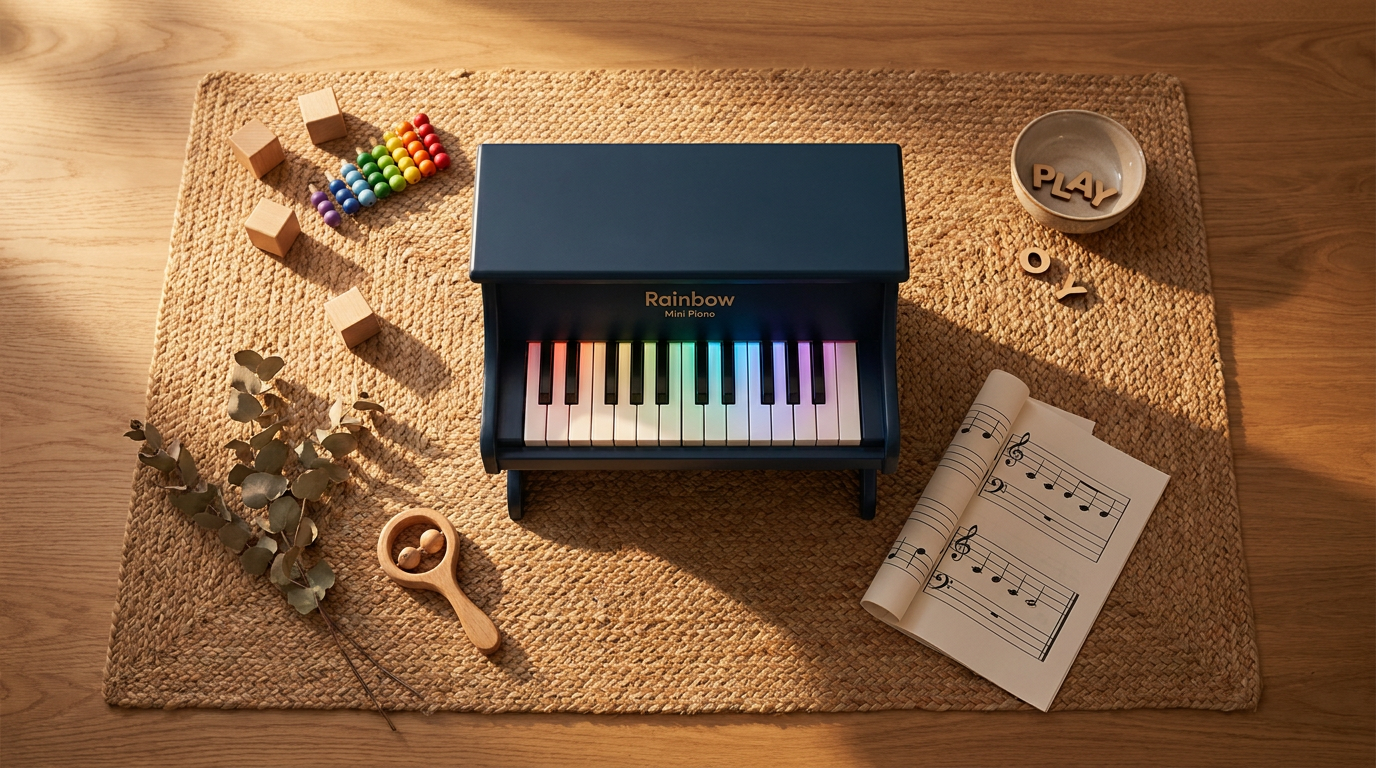
Here's the part nobody talks about: simply applying a rainbow palette to a keyboard does not make it a Montessori tool. For the colors to have a pedagogical purpose, they must function as a 'control of error'—a self-correcting mechanism that allows the child to identify and fix their own mistakes. When a red key always corresponds to the note C, the child learns a direct, reliable association between a visual cue and an auditory outcome. This turns a simple keyboard into a powerful tool where a rainbow piano for sensory play becomes a structured lesson in musical patterns. Most mass-market toys use color as arbitrary decoration, which has no educational value and can even add to the cognitive confusion.
Agency vs. Passive Entertainment
I'll change my mind about most digital kids' instruments when they stop including 'demo' buttons. Pre-recorded songs and flashing lights are passive features that remove the child's agency. They teach a child to be entertained rather than to explore and create. A true educational instrument requires the child's direct physical action to produce a result, creating a clear link between cause and effect. The goal is to empower the child as the creator of the music, not as the trigger for a pre-programmed playback. A well-designed toddler rainbow musical toy puts the child in control, allowing them to experiment with pitch, rhythm, and volume through their own efforts. This distinction is critical when selecting from the many small musical gifts for kids available.
What makes a piano toy truly Montessori-aligned?
A piano toy aligns with Montessori principles when it isolates a single concept, in this case, musical pitch. It should empower the child to be an active creator rather than a passive observer. This means no distracting lights or pre-recorded demo songs. Furthermore, any features like color-coding must serve as a 'control of error,' creating a logical and consistent system for the child to learn from, rather than being purely decorative.
Are rainbow colors on a toy always Montessori?
No. Rainbow colors are only aligned with the Montessori method if they serve a specific, logical purpose. If the colors are used as a 'control of error'—for example, each color consistently represents a specific musical note across octaves—then they are a functional educational tool. If the colors are merely decorative and lack an underlying system, they do not meet the Montessori standard and can be considered a distraction.