A Better Test for Your Toddler's First Rainbow Musical Toy
 Priya RamanSenior Analyst
Most rainbow-colored objects marketed as musical toys for toddlers fail at their primary job: teaching music. Parents are encouraged to choose items based on bright colors and multiple functions, but this approach overlooks the core qualities of a true instrument. Stop evaluating toddler musical toys on color and number of functions; use the "Pitch, Permanence, and Playability" test to find a true first instrument.
This framework moves beyond aesthetics to assess a toy's real educational value. It prioritizes a toy's ability to function as a predictable, durable, and focused tool for auditory development.
The Pitch Test: Is It an Instrument or a Noisemaker?
The first dimension is pitch. A true instrument produces chromatically accurate notes, while a simple toy makes a series of arbitrary, untuned sounds. When a child presses a red key and consistently hears a C note, they begin to form a foundational understanding of musical structure. This predictable feedback is critical for early brain development, helping to build the neural pathways associated with music and cognition.
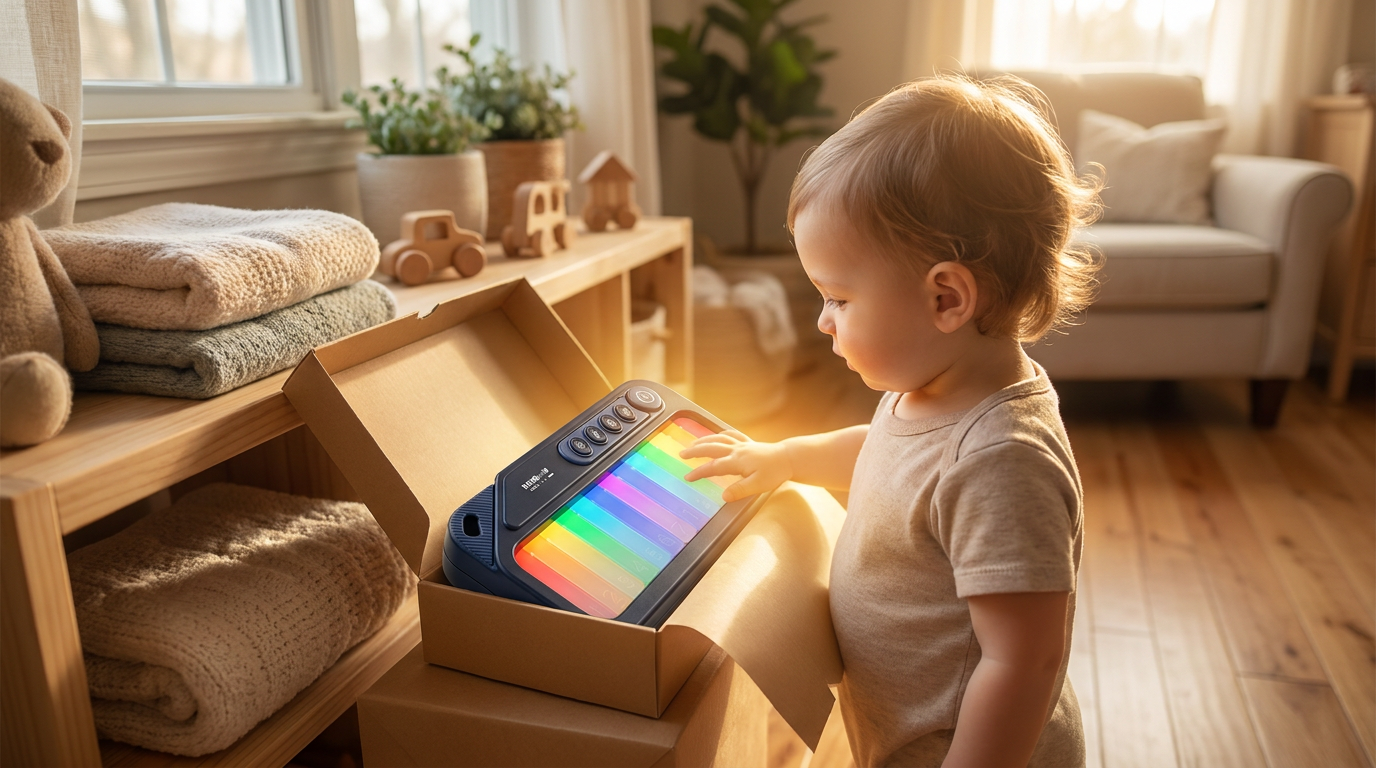
Many popular rainbow xylophones and bell sets, especially those made of wood, lose their tuning with use or are inaccurate from the start. The Rainbow Mini Piano is engineered with a digital sound chip to ensure every key plays the correct note, every time. This acoustic integrity transforms it from a noisemaker into a reliable learning device.
The Permanence & Playability Test: Built for Music or Distraction?
Once pitch is established, the next evaluation considers the product's design. Two axes matter here: the durability of its musical function (Permanence) and the clarity of its user interface (Playability).
Permanence refers to an instrument's ability to maintain its acoustic performance over time. A toy whose primary feature is stacking, with musical bars added as a bonus, is not engineered for musical longevity. The Rainbow Mini Piano is built first as an instrument; its durable, BPA-free plastic construction protects the internal electronics, ensuring its pitch remains stable through years of play.
Playability measures whether the interface encourages focused musical exploration or distracts with non-musical tasks. Toys that combine a xylophone with a shape sorter or stacking rings divide a child's attention. The decision rule: if the goal is musical development, the interface must be dedicated to that purpose. The piano-style keys of the Rainbow Mini Piano isolate the action of making music, helping toddlers develop finger strength and associate a specific physical action with a specific sound. This focused design is essential for a productive rainbow piano for sensory play, where the auditory response must cleanly map to the child's action.
What makes a musical toy truly Montessori-aligned?
A toy aligns with the Montessori philosophy when it is purposeful and allows for self-correction. An instrument with inaccurate or inconsistent pitch actively works against this principle, as the child cannot independently verify the result of their actions. Because the Rainbow Mini Piano provides a stable, predictable sound for every color-coded key, it supports the child's ability to learn and repeat musical patterns. This consistency is the central argument in the Montessori piano toy contradiction, which questions whether untuned toys can fit the philosophy at all.
Is a rainbow xylophone or a rainbow piano better for toddlers?
When evaluated with the Pitch, Permanence, and Playability test, a well-engineered rainbow piano is superior for musical development. While a xylophone introduces a percussive action, its pitch is often inconsistent and its bars are prone to damage. A digital piano like the Rainbow Mini Piano offers perfect pitch, high durability, and a focused interface that promotes fine motor skills. Once you see it this way, the piano becomes the clear choice for a child's first instrument, making it one of the best small musical gifts for kids who are ready for structured auditory learning.